
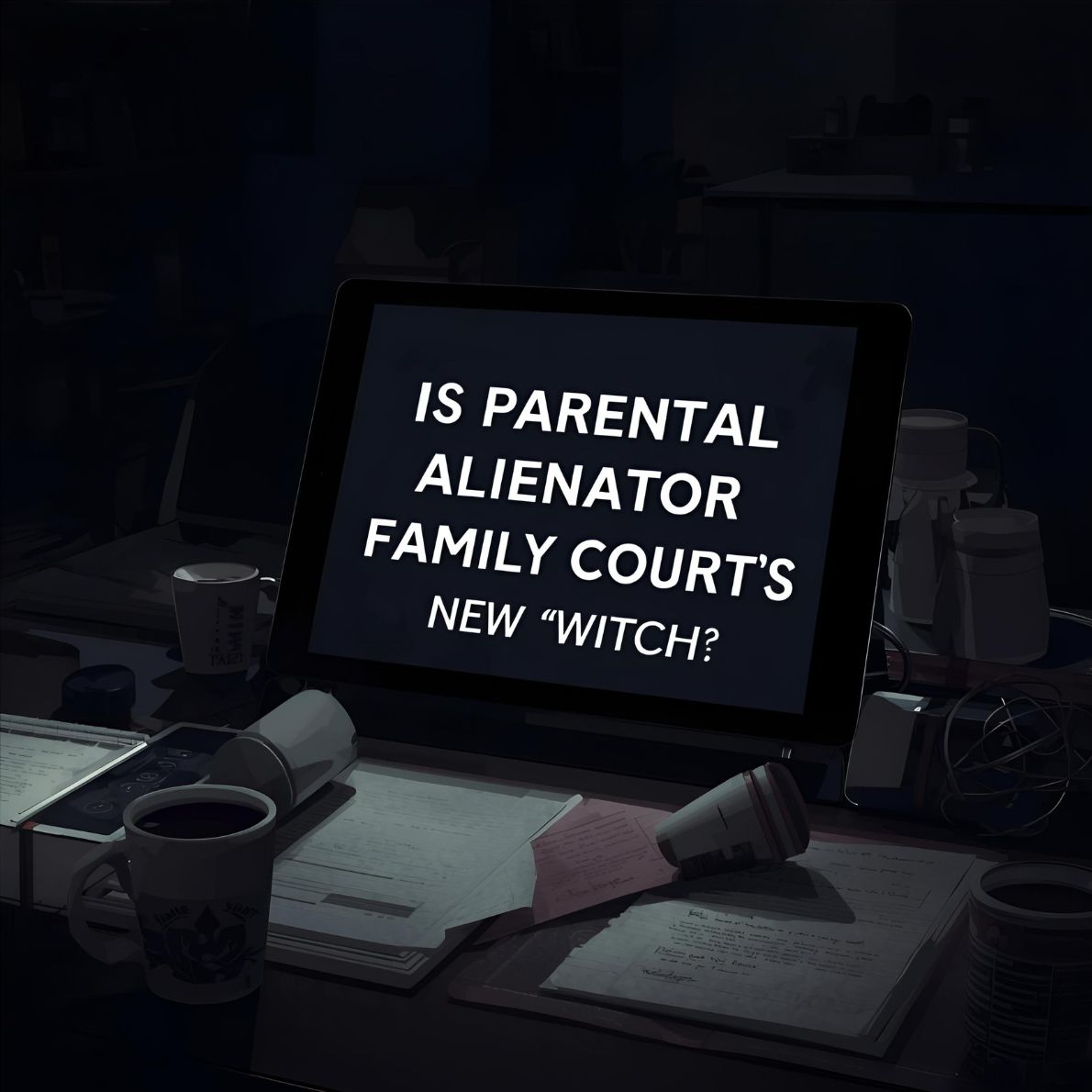
Institutional Betrayal: From “Witch” to “Parental Alienator”—How Family Courts Silence Protective Parents
Disclaimer: It is important to acknowledge that not all victims of coercive control are women, and not all coercive controllers are men. People of all genders can experience or perpetrate coercive control. However, statistically and according to extensive research, the harms of coercive control are predominantly, and most dangerously, inflicted against women. This reality is reflected in both prevalence data and the severity of outcomes observed in family courts and related systems. This work discusses the concept of parental alienation, which does have some scientific validity as a phenomenon observed in certain family dynamics. However, when these concepts are applied within systems marked by structural inequality, their application can become unjust and may further silence or harm protective parents.
When we look back at history, the term “witch” sends a chill down our collective spine—not just because of what it represented, but because of what it enabled. For centuries, being called a witch was all it took for society to turn against you: your credibility was destroyed, your voice was silenced, and your fate was sealed. In my work as the founder of The Quicksand Model® and End Coercive Control USA, I see a chilling parallel in how the label “parental alienator” is used in today’s family courts. The witch hunts may be history, but the mechanisms of scapegoating and silencing—especially against protective mothers—are alive and thriving under new terminology.
The Quicksand Model®: How Victims Sink in Family Court
The Quicksand Model® was born from my research and lived experience in the coercive control and domestic abuse fields. It illustrates how survivors of coercive control, when trying to protect themselves and their children, are pulled deeper into danger by the very systems meant to help them. Family courts, tragically, have become a central part of this quicksand.
Here’s how it works:
- Targeted Victims disclose abuse or seek protection for their children.
- Coercive Controllers counter with accusations of “parental alienation.”
- The court, primed by systemic biases and pseudoscientific frameworks, shifts its focus from the alleged abuse to the supposed alienation.
Just as women were once branded “witches” for daring to speak out or resist control, today protective parents—especially mothers—are branded “parental alienators” for asserting boundaries or seeking safety. The result? The more you try to protect your children, the deeper you sink into the quicksand of counter-allegations and institutional disbelief.
Parental alienation refers to a situation where one parent is accused of turning a child against the other parent, often in the context of custody disputes. While research recognizes that some cases involve genuine alienation, critics highlight that the concept is sometimes misused in legal settings. Recently, there has been an uptick in cases where protective mothers have been jailed for trying to safeguard their children from alleged abuse, raising concerns about how these frameworks are applied—particularly when the courts dismiss mothers’ concerns as “alienation.” This trend underscores the urgent need for nuanced, trauma-informed approaches in family law.
Systemic Coercive Control: The Court as Perpetrator
Coercive control is not just an interpersonal tactic wielded by abusers; it is also systemic. Family courts, whether knowingly or not, have adopted frameworks and practices that mirror the dynamics of coercive control on an institutional scale. By rebranding the “witch” as the “parental alienator,” the system:
- Discredits protective parents, especially mothers, stripping them of agency and credibility.
- Diverts attention from the patterns of abuse, focusing instead on the supposed failings of the survivor.
- Enforces silence—because speaking up about abuse only leads to more suspicion and punishment.
This is systemic coercive control: a process where the very structures tasked with protection become mechanisms of further entrapment.
The Danger of the “Parental Alienator” Label
We must recognize that “parental alienation” is often used against those who are already most vulnerable. Just as the witch trials punished women for defying the status quo, today’s family courts often punish mothers for trying to keep their children safe. The “parental alienator” label has become a modern tool of social control, wielded with the same disregard for evidence and the same appetite for scapegoats.The Quicksand Model® shows us that, once this label is applied, escape becomes nearly impossible. Protective parents are pulled under by legal processes that are stacked against them, with devastating consequences for both them and their children.
A Call to End the Witch Hunts—For Good
We cannot allow our family courts to perpetuate these modern-day witch hunts.
- We need courts to understand the realities of coercive control and the way it operates both interpersonally and systemically.
- We must demand evidence-based practice—not reliance on debunked and pseudoscientific notions of “parental alienation.”
- We must listen to survivors and children, not silence them.
- We need to #PivotToThePerpetrator and shift from victim-blaming to true transparency and accountability.
- We must motivate professionals to transform policies that perpetrate institutional violence into systems that promote institutional courage.
If you or someone you know is sinking in the quicksand of the family court system, know that you are not alone. At End Coercive Control USA, we are working to expose these patterns and motivate stakeholders to transform systems. Our mission is to ensure that the “witch hunts” of the past do not continue under new names and new excuses.
Let’s name the quicksand, expose the systemic coercive control, and end the cycle of rebranding victims as villains. The safety of children and survivors of abuse depends on our willingness to see—and challenge—these modern parallels.
With hope and solidarity,
Kate Amber MSc
Founder, The Quicksand Model® & End Coercive Control USA
Find resources, support, and more information about The Quicksand Model® at End Coercive Control USA.
Together, we can end systemic coercive control in family courts and throughout social systems worldwide.
About the Author
Kate Amber, MSc, is dedicated to ending coercive control and promoting healthy relationships. Her work with End Coercive Control USA focuses on providing insights and support for those striving to create compassionate and respectful connections.
The Quicksand Model™ Training Programs are available for schools, groups, religious organizations, non-profits, businesses, government etc.
Free Consultations: coercive control expert witness & coercive control consulting for survivors
Free Consultations: coercive control speaker, trainer, consultant or expert witness for organizations, companies & systems
Nothing in this blog is intended to diagnose or treat. It is for informational purposes only.
Hello!
I’m Kate. Welcome to my blog. Please feel free to comment & disagree. Critical Thinking is WELCOME!
Recent Posts